How much does visual identity cost in 2026? Prices, package scope and where not to cut corners
Visual identity pricing in 2026: PLN 2,600 for a starter package, PLN 4,600 for a complete package. Scope, cost factors and where cutting corners backfires.
Visual identity pricing at a glance
Our visual identity costs PLN 2,600 for the starter package and PLN 4,600 for the comprehensive package. We complete the first in 14 days and the second in 21. All prices exclude VAT.
Starter package: PLN 2,600, 14 days - logo, business cards, letterhead and email signature. Comprehensive package: PLN 4,600, 21 days - the same plus a logo manual, social media templates and brochures.
The Polish market has a wider spread because very different things are sold under the same label. A freelancer typically quotes PLN 1,500-4,000 for identity, a small studio PLN 4,000-12,000, and a large branding agency starts at PLN 20,000, going higher when brand strategy, naming and research are involved. This is not a difference in drawing quality. It is a difference in how much of a system you buy and who takes responsibility for implementing it.
Three things to know before comparing quotes:
- Identity is not a logo. The mark is one element. The rest consists of rules that make a business card, PDF proposal, Instagram post and trade fair banner look like one company. We price the mark separately, from PLN 650, and explain it in our article on how much a logo costs.
- The price depends on the number of applications, not the number of hours. A service business with a business card and email signature has a different scope from a manufacturer printing catalogues, labels and an exhibition backdrop.
- The most expensive version is the one done twice. A cheap logo without documentation returns two years later as rebranding, except now you also have to replace everything you have printed.
Below, I break down the price list item by item, explain what really increases branding costs, and show where saving makes sense and where it costs more than it saves. There is also a separate section for furniture manufacturers, whose identity requirements differ from those of service businesses.
Read onWhat visual identity includes, and what is only a logo
The most common misunderstanding in a quote goes like this: a client asks for identity, means a logo, receives a proposal for a system and is surprised by the price. Or the reverse: they buy only the mark, then a month later nobody knows which shade of orange to use in a presentation.
The distinction is simple. A logo is a mark. Identity is the set of decisions and materials built around it so people can use it without involving a designer in every file.
A system usually has six layers. The logo in all variants: horizontal, vertical, symbol alone, single-colour and reversed on a dark background. A palette defined in four colour spaces, because colour is specified differently on a screen, in offset printing and when ordering vehicle wrap film.
Typography: primary and secondary typefaces plus hierarchy rules. A grid and composition rules that give next year’s banner the same proportions as today’s flyer. Business materials, meaning actual ready-to-use files. Finally, the logo manual: the document tying everything together that you send to every new supplier.
Package scope, element by element

Swipe across the screen
Element
Why you need it
Starter PLN 2,600
Comprehensive PLN 4,600
brand your website, invoices, signs and avatars without improvisation
the same colour on screen, in print and on a vehicle wrap
proposals and letters look like company documents, not generic Word files
the brand’s most frequently viewed medium, sent dozens of times a day
posts, stories and banners made without a designer, in one visual style
the design develops through discussion, not a single attempt
the mark is yours to register and take to another designer
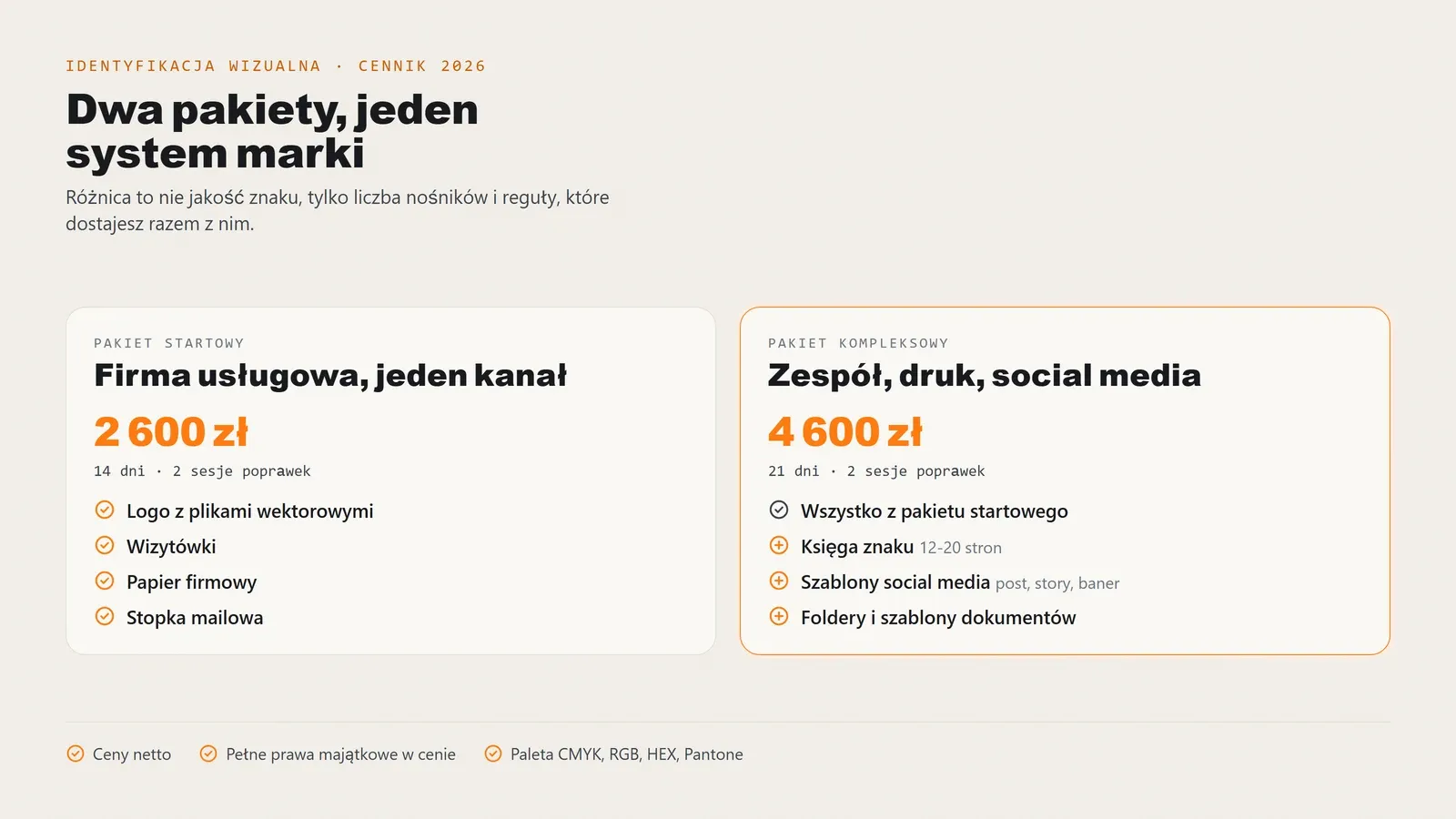
The dividing line between packages is exactly where one person stops managing the brand alone. As long as you do everything yourself, a complete file set is enough. Once a salesperson, assistant, printer and social media specialist become involved, you need a document telling them what is allowed and what is not. That document is the logo manual, and it accounts for most of the PLN 2,000 difference between packages.
Quick test: count how many people other than you sent a file bearing the company logo outside the business last month. If more than one, the starter package will lead to adding materials piece by piece.
It is also useful to know what identity does not normally include. Company naming and brand strategy are separate processes, usually more expensive than the visual layer itself. Printing is not included: our partner printer handles it, and you pay directly. Trademark registration with the Patent Office is a separate procedure with its own fees. A website is not included either, although identity is its natural starting point.
Visual identity: 2026 prices
Let us start with our rates, because those are the only figures we take responsibility for. Then we will look at market ranges so you have something to compare them with.
DigiDraft packages and standalone logo prices
Swipe across the screen
Item
Scope
Turnaround
Price excl. VAT
2 concepts, 2 revision sessions, SVG/PNG/PDF files
business cards, flyers, banners, billboards, brochures
layout, photo composition, typography, print-ready file
PowerPoint or Google Slides template based on the identity
data layout, icons, print and social media versions
animated logo, product icons, micro-interactions
The full list, alongside other services, is in the agency price list. Three things not visible in the table affect the bill: every project includes 2 revision sessions, additional rounds cost PLN 120 per hour, and 72-hour express delivery with a 50% surcharge applies to Logo Basic and Standard. We quote faster delivery of a complete identity separately because it means shifting other projects in the schedule.
Market ranges: freelancer, studio, branding agency
The figures below reflect publicly available Polish offers without naming individual companies. Treat them as indicative ranges, not a price list.
Freelancer: PLN 1,500-4,000. One person, often designing after hours or running a sole proprietorship. You receive a logo, a few materials and usually a short note on colours and fonts. The strengths are price and direct contact. The weaknesses are availability a year later when you need a missing file, and a lack of documentation that turns every new graphic into an interpretation rather than an application of a rule.
Small studio: PLN 4,000-12,000. A team of two or three people, or a narrowly specialised agency. The scope includes a logo manual, complete production files, contractual rights transfer and support with initial print runs. Our PLN 2,600-4,600 packages sit near the bottom of this range because we work without account managers and without a brand strategy stage, which is a separate, costly part of higher-priced processes.
Large branding agency: from PLN 20,000. At this budget, you are buying a strategic project rather than a visual layer: market research, positioning, brand architecture, sometimes naming and verbal communication. It makes sense for brands entering several markets, managing sub-brands or facing positioning mistakes that could cost millions. For a service business in Podlasie or a single-product startup, it is more than needed.
What determines the cost of visual identity
Quotes differ not because someone charges more per hour, but because the same term hides different scopes. Seven factors account for almost all the difference.
1. Number of applications
This is the main multiplier. A service company needs a logo, business card, letterhead and email signature. A manufacturer also needs labels, packaging markings, a catalogue and an exhibition backdrop. A physical shop adds a sign, window display, interior signage and bags. Each application has its own format, printing technique and constraints. A logo that works perfectly on a business card needs a simplified version when embroidered on a polo shirt.
List the applications before asking for a quote. Two sentences in an email can move the price by several thousand in either direction.
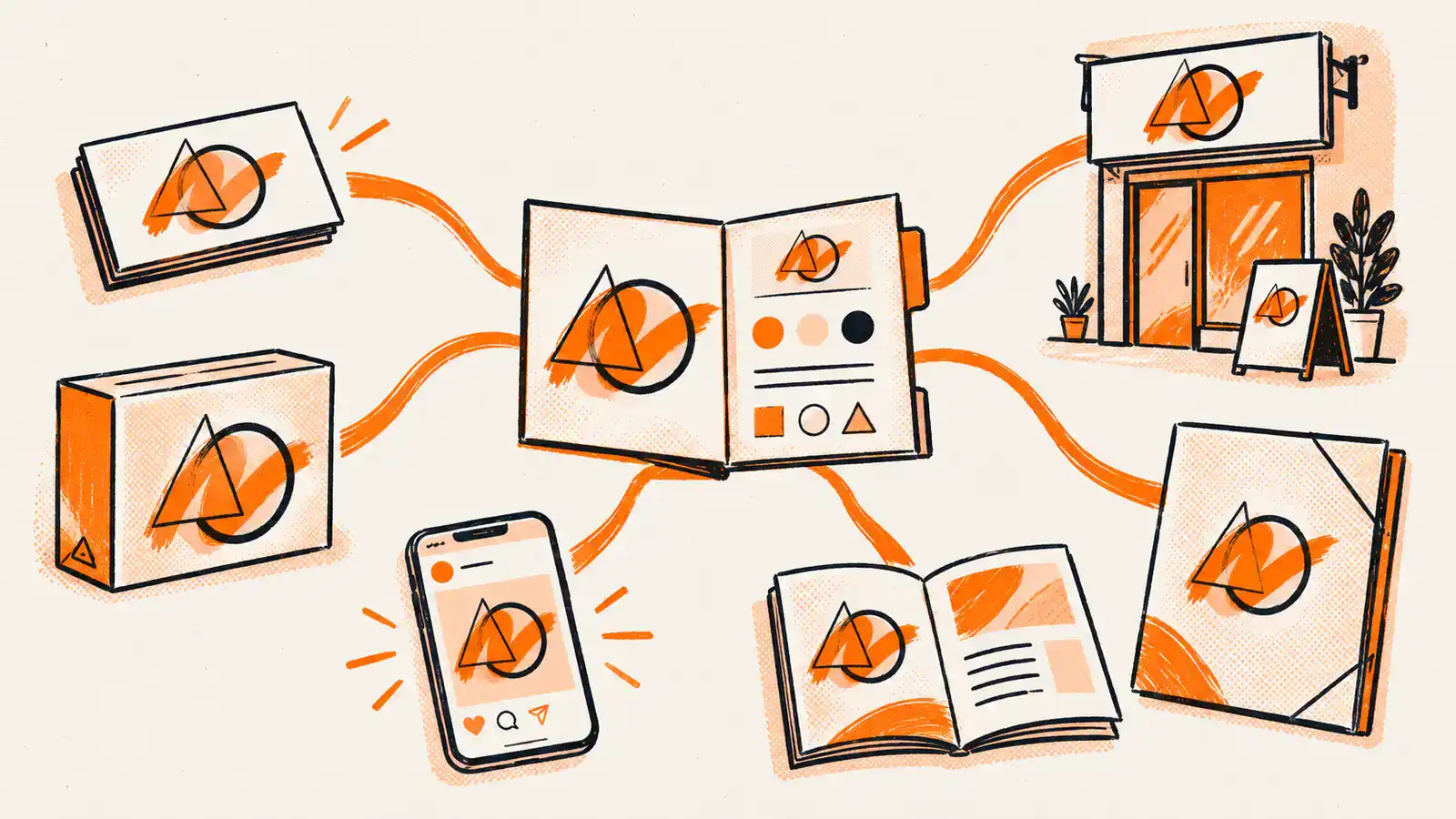
2. Logo manual
The most underestimated item is also one of the biggest reasons quotes differ. A manual’s price reflects its length and detail. A mini brand guide of a few pages is included in Logo Standard at PLN 1,100. A full 12-20-page manual with clear space, minimum sizes, background variants, typography rules and prohibited uses is part of the comprehensive identity package and Logo Full.
A manual is not corporate decoration. It is the instruction document you send to a printer, merchandise supplier and social media freelancer instead of explaining separately to each how the brand should look.
3. Number of concepts
Every concept is a separate direction developed far enough to evaluate. Two are enough when the brief is precise and you know what you want. Three give more choice and more often lead to a decision without an extra round. More than three usually blur the decision rather than help. Five versions of the same idea in five colours are not a choice, but the illusion of one.
4. Revision rounds
The price includes 2 revision sessions at each stage: logo, palette and manual. With specific feedback, that is enough to complete the project. Additional rounds cost PLN 120 per hour and, in practice, occur almost exclusively when several client-side decision-makers disagree.
The biggest saving in the entire project is here, and it costs nothing: appoint one decision-maker and collect comments in one message. “The text is too close to the symbol; the symbol is too heavy on the left” moves the project forward. “I am not feeling it” takes it back to the beginning and consumes a revision round.
5. Copyright
A proposal without economic copyright transfer will always be cheaper. But you are buying the right to use someone else’s design, not the design itself. The problem only surfaces during trademark registration or a change of supplier, exactly when negotiations are least welcome.
We include full economic rights transfer in every package, by contract together with the source files. Ask every supplier about this before the deposit, not after delivery.
6. Deadline
Standard timelines are 14 days for starter and 21 for comprehensive. A shorter deadline means rearranging other projects, so it costs extra. Logo Basic and Standard have a fixed 72-hour express option with a 50% surcharge. We quote accelerated full identity individually because shortening a workshop and moodboard stage affects decision quality, not just working speed.
7. Implementation
Design is one task; implementation is another. Replacing the logo on the website, in the CMS, advertising campaigns and social profiles is separate work priced by scope. So is preparing files for a particular printer or signage manufacturer. With an extensive online presence, this stage can cost as much as the design itself. Plan for it at the start rather than discovering it afterwards.
What is not worth paying extra for, and where saving backfires
Not every branding line item does the same amount of work. Some things can genuinely wait or be skipped; others return as a bill a year or so later. Let us separate them clearly.
Things you can safely skip
- Five logo concepts instead of three. More options mean a longer discussion, not a better choice. Three polished directions are the most you can properly assess.
- A 60-page manual. For a business employing a dozen or so people, 12-20 pages cover everything a printer and contractor actually use. The rest is length for its own sake.
- An animated logo at launch. 2D animation from PLN 600 makes sense when you already have a video channel or campaigns. Without those, it stays in a folder.
- Merchandise in year one. Pens and mugs do not build recognition for a brand the customer does not yet know. Return to them once people recognise the mark.
- Immediate trademark registration. It is worth doing, but not in the same week as the design. First see whether the brand and name survive the first six months on the market.
Savings that return as a bill
- No vector files. A JPG logo ends with a call from the printer and redrawing from scratch at a cost comparable to a proper design.
- No rights transfer. Without a contract, you cannot register the mark or change supplier without the previous one’s consent. The most expensive item missing from the quote.
- No CMYK and Pantone palette. Screen colours print differently. Without print definitions, every printer produces its own shade.
- No manual for a team. When several people create materials without rules, the brand drifts within six months, and unifying it costs more than the manual.
- A mark untested at small sizes. A logo unreadable at 32 pixels means a broken favicon, avatar and product marking. The problem always appears after implementation.
The most common false economy we see is ordering only a logo and planning to buy everything else later, item by item. The bill then looks like this: Logo Standard at PLN 1,100, business cards and letterhead from the advertising materials range, social templates at PLN 120-240 each, then a brochure.
After four or five months, you have everything and have spent about as much as on a package, but you lack the one thing you cannot buy separately: a coherent system designed together. Materials made individually, at intervals and with different details in the designer’s mind simply do not look like one family.
Buying piece by piece makes sense in one case: when you genuinely do not know whether the business will launch. Then a PLN 650 logo is a sensible minimum, and you add the rest when the first customers arrive. We explain this in more detail in our article on logo costs and what you actually pay for.
Visual identity for a furniture manufacturer: what is different?
Podlasie is a furniture manufacturing centre, and we receive branding quote enquiries from this industry more often than any other. Identity scope differs here from services, and it helps to know why before comparing your quote with one for a construction firm or law practice.
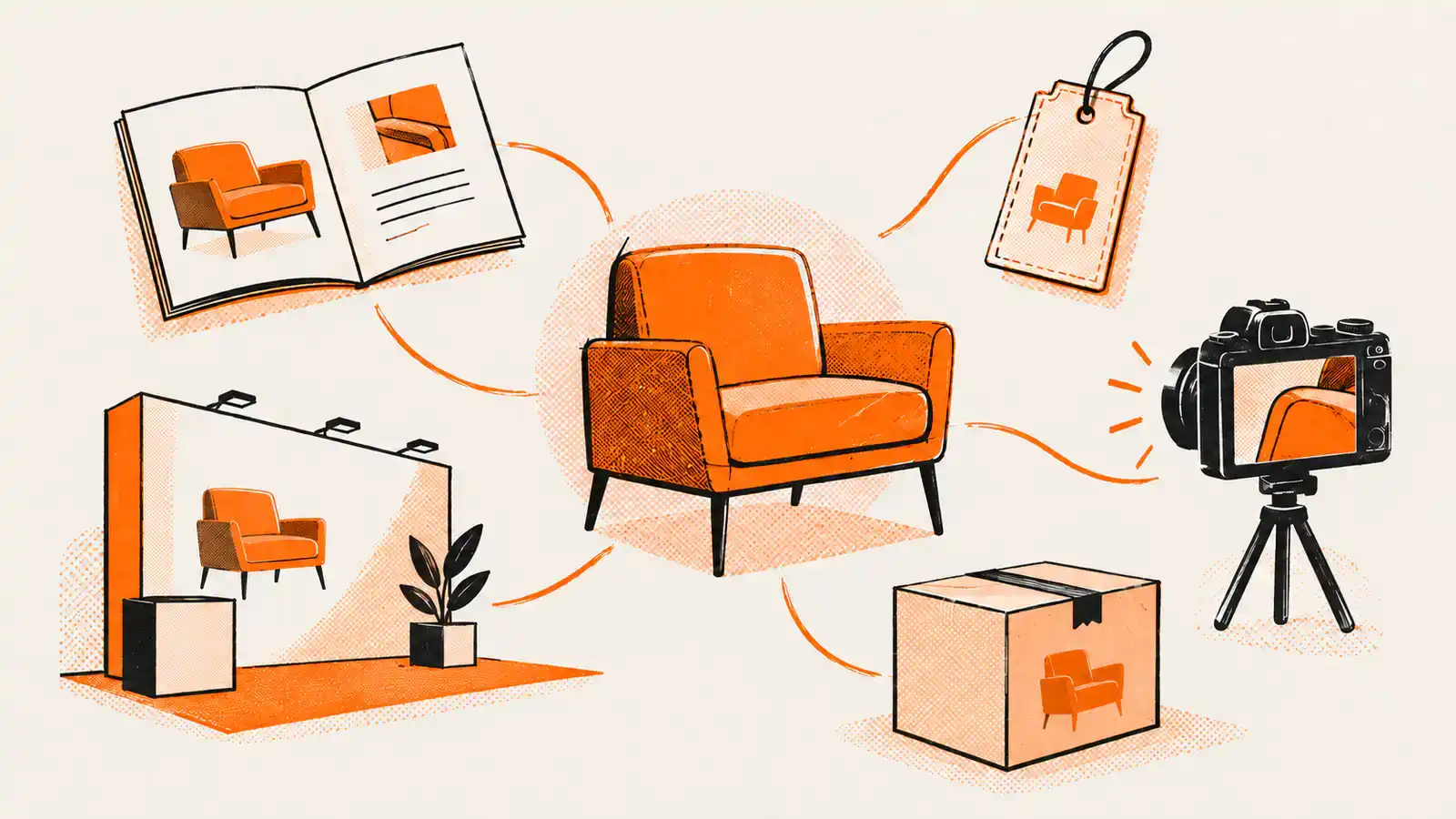
A furniture manufacturer sells something customers look at, touch and compare with competitors two stands away. The logo is not the main carrier of the brand. What matters most is how the product looks in a photograph, catalogue and display. Identity has to adapt to that, not the other way around.
Four things absent from a standard service-business package
A service business finishes with a business card and email signature. A furniture manufacturer is only starting there: its brand lives on the product, in the catalogue and on the stand. Four items almost always added in this industry:
Swipe across the screen
Element
Why furniture manufacturers need it
Price
A basic sales tool, not an extra. Without one, a salesperson has nothing to take to a trade fair or retail chain. We design a layout that can grow with new collections without redesigning everything.
PLN 900 for up to 10 pages: layout, photo composition, typography and print-ready file
An upholstery tag, packaging sticker, specification plate and assembly instructions. Different formats, surfaces and printing methods. Together they make the first impression after unpacking.
PLN 150-380 per item, from the advertising materials range
Backdrops, roll-ups and stand graphics. The brand appears at the greatest distance and under the worst light, so the mark needs a version legible from a dozen metres or more, and the palette must not disappear into the hall lighting.
PLN 150-380 per item; logo and palette variants included in the package
Often overlooked, yet decisive for brand perception. The catalogue, website and social channels show the same furniture: different backgrounds, colour temperatures and framing can undermine any palette. We document background type, light direction, framing and detail shots in the manual.
Included in the logo manual (comprehensive package)
What it actually costs
The base is the same as for any other business: PLN 2,600 for starter or PLN 4,600 for comprehensive. The difference lies in extras that furniture businesses almost always need immediately, not “someday”.
A furniture manufacturer’s typical starting budget: comprehensive package PLN 4,600 plus product catalogue PLN 900 plus several labels and signs at PLN 150-380 each. The total is usually PLN 4,000-7,000 excluding VAT, depending on how many markings are included immediately and how many you add before trade fair season.
A sequence that saves money: photograph the products before designing the catalogue, not afterwards. A catalogue laid out around existing photographs has one price. A catalogue designed for photographs yet to be taken ends with adapting the layout to the actual shots.
One final point: furniture logos often go on difficult materials such as wood, fabric, metal and film. The single-colour, simplified version is therefore not an interesting page in the manual but an everyday working version. If a supplier does not ask about this during the brief, you will receive a logo that looks good on screen and falls apart when engraved.
How to compare visual identity proposals
Two quotes differing by PLN 1,500 can differ by half the scope. The total at the bottom tells you nothing until you know what sits above it. These are the questions we ask when comparing competitors’ proposals for a client. Send the same email to every supplier, and the answers will put the comparison in order.
- Exactly which files do I receive? Not “a complete set of materials”, but a list of formats. It should include editable .ai and .svg files, a manual PDF, font pack and mock-ups. If the proposal ends with a JPG preview, you will return in six months for files nobody has.
- Who owns the economic copyright after delivery? The answer should be: the client, transferred by contract. A one-year licence or silence on this point means you should ask before paying a deposit.
- How many concepts and revision rounds are included? And what happens once they are used up? We include 2 revision sessions per stage, then charge PLN 120 per hour. A supplier without an answer will price it mid-project, when you have little room to manoeuvre.
- Does the palette include CMYK and Pantone? HEX alone is enough for a website and insufficient for print. This question immediately shows whether the supplier has worked with a printer.
- Has the logo been tested at small size and in one colour? Ask for a 32-pixel preview and a single-colour version. Thirty seconds can eliminate half the proposals.
- What happens with printing? Do you receive print-ready files, or does the supplier order printing, and with what markup? We design and deliver the files; printing goes directly to our partner printer.
- Who leads the project and who do I speak to? In small teams, the designer and contact person are the same. The longer the chain, the more gets lost between brief and file.
- What is outside scope? Almost nobody asks this question, yet it often saves the budget. Naming, strategy, website implementation, trademark registration and photography can each be separate line items.
With eight answers from two or three suppliers, comparison becomes straightforward. It usually turns out that the cheapest proposal was not the cheapest, just the shortest.
The process and a 14- or 21-day schedule
The quote tells you what you pay. The schedule tells you when and what we need from you to keep that figure unchanged. Our process has four stages and takes 14 days for starter or 21 for comprehensive.
Days 1-4: brief and moodboard. We start with a workshop about brand values, customers, competitors and business goals, not personal taste. Then we show 2-3 visual directions: colour, typography and character. We choose one before anyone opens a graphics application. This stage determines everything else, so this is the time to speak up.
Days 5-9: logo and mark. We design 2-3 concepts in the chosen direction and refine the final version over two revision sessions. We test extremes: favicon, single-colour version, reversed on a dark background and the largest format you expect to use. We explain what separates a good mark from a pretty one in our article on creating a logo that attracts attention.
Days 10-12: system and business materials. We define the CMYK, RGB, HEX and Pantone palette, typography and grid: the rules keeping the brand consistent. We use them to design business cards, letterhead and email signatures, plus brochures and social media templates in the comprehensive package. This shows why the workshop mattered: each material follows decisions made in week one, rather than improvisation.
Days 13-14 (or up to 21): manual and handover. We deliver the 12-20-page manual, source files, font pack, mock-ups and a contract transferring full economic rights. This stage takes longer in the comprehensive package because the manual covers more applications.
The schedule assumes one thing only: that you return with decisions. Identity design is held up by client approval, not the designer. A brief returned a week late and silence after the first presentation can stretch two weeks of work into a month and a half. If the brand needs to debut on a particular date, such as a trade fair or opening, count backwards from it and add a printing buffer of several more working days.
Implementation remains after handover. The identity needs to reach the website, CMS, campaigns and social profiles. Some clients do it themselves using the manual; others commission us. If regular content production is involved, plan who will create the graphics, because the comprehensive templates work best in the hands of someone publishing consistently. That is what social media management handles, turning identity into a specific publishing calendar.
Does visual identity pay off, and how do you calculate it?
Branding has no simple return metric because it does not sell directly. It can, however, be costed over time, which usually provides enough information to decide.
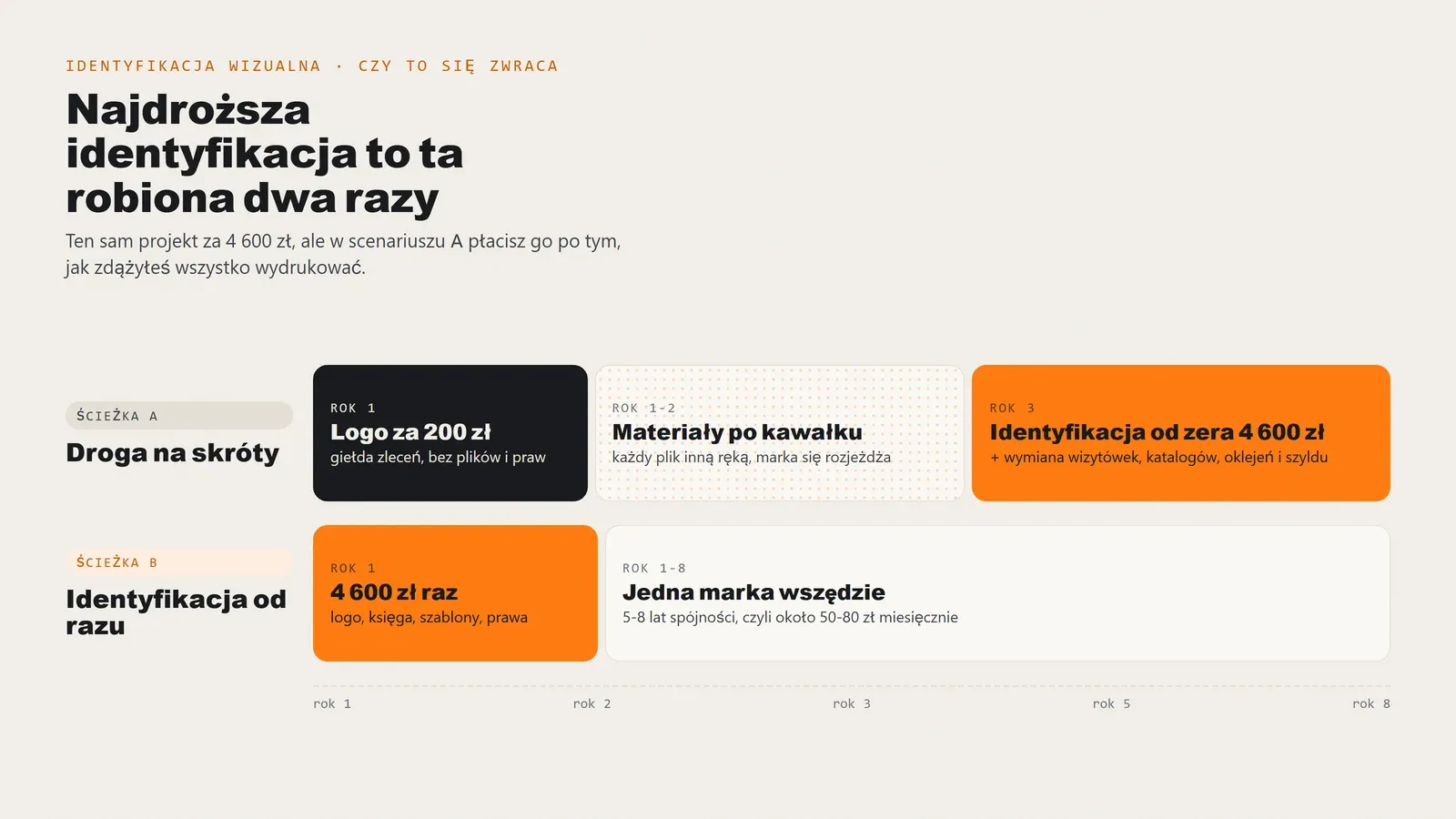
A well-designed identity lasts 5-8 years before it needs refreshing. Spread PLN 4,600 over that period. It works out at around PLN 50-80 a month for a company to look consistent everywhere: email, business cards, PDF proposals, banners and posts. Less than a salesperson’s phone subscription. This is not rhetorical arithmetic but the appropriate unit of measurement: identity is a one-off cost spread over years of use, not one month’s expense.
The second, less pleasant figure is the cost of a shortcut. We regularly see the same scenario. A company starts with a PLN 200 marketplace logo. Over two years it adds materials piece by piece without rules, making each file a separate interpretation. In year three it enters a bigger market and discovers that the mark cannot be registered because rights were never transferred and its shape looks suspiciously like a free library icon.
It then pays for identity from scratch and replaces everything already printed and branded: business cards, catalogues, wraps and signs. The design still costs PLN 4,600, but replacing the applications in a manufacturing business can cost many times more.
The third factor has no price in a table, but you see it in sales conversations. A consistent brand closes the distance. A customer who receives a proposal on letterhead, a matching business card and an email with a clear signature does not wonder whether the company is serious. For orders worth tens of thousands of zlotys, that is not cosmetic: it is one of the signals people use to decide whom to trust with their money.
When does identity not pay off? When you buy it instead of selling. If you have no product, customers or channel to reach them, the most beautiful manual fixes nothing. It is better to take a PLN 650 logo, launch and return for a system when there is something for it to support.
Summary: what to remember from this price guide
Our visual identity costs PLN 2,600 for starter and PLN 4,600 for comprehensive, with 14- and 21-day timelines, excluding VAT. In Poland, the same service ranges from PLN 1,500 with a freelancer to over PLN 20,000 at a large branding agency, because one label covers everything from a file bundle to a strategic research project. The differences are the number of applications, manual, concepts and revision rounds, copyright transfer, deadline and whether implementation is included.
You can skip a fifth logo concept, a sixty-page manual and first-year merchandise. Do not skip vectors, CMYK and Pantone definitions, small-size testing or a contract transferring economic rights. Each missing item returns as a bill larger than the saving. Furniture manufacturers should add a PLN 900 product catalogue and signage at PLN 150-380 per item, bringing a realistic starting budget to PLN 4,000-7,000.
Compare scope, not the total. The eight questions in the comparison section cover it in one email. To see all branding items together, use the price list; we break down the mark itself in our logo and logotype design service. Flyers, banners and brochures added afterwards are in our advertising materials service.
FAQ: common questions about visual identity prices
Six recurring questions about branding quotes: why freelancers and agencies differ, what the price includes, what rebranding costs, how long design takes, who owns the files, and furniture-industry budgets. Short answers here, with fuller explanations above.
Why does visual identity cost less with a freelancer than an agency?
Usually because the scope and responsibility are different. A freelancer charging PLN 1,500-4,000 typically delivers a logo, a few materials and a short note on colours. A studio charging PLN 4,000-12,000 adds a logo manual, complete production files, contractual rights transfer and print support. The difference appears six months after delivery, when someone else makes a flyer and needs rules to follow.
What exactly is included, and what do I pay for separately?
The package includes design, 2 revision sessions at each stage, complete files (PDF manual, editable .ai and .svg files, font pack and mock-ups), a CMYK, RGB, HEX and Pantone palette, and contractual transfer of full economic copyright. Printing, revision rounds beyond the two included (PLN 120 per hour), and materials outside the package are separate, such as a PLN 900 product catalogue or individual social media graphics at PLN 120-240 each.
How much does rebranding an existing identity cost?
We price rebranding by the extent of the changes, because adjusting a logo and rebuilding a whole system can differ tenfold in cost. The same packages remain the reference: PLN 2,600 for starter and PLN 4,600 for comprehensive. If the brand has a recognisable mark, we often keep its structure and rebuild colour, typography and materials around it. Existing content, photographs and copy also help lower the cost.
How long does visual identity design take, and can it be faster?
Starter takes 14 days and comprehensive takes 21. That covers the workshop, moodboard, logo concepts, 2 revision sessions and final manual. The 72-hour express option with a 50% surcharge applies to Logo Basic and Standard. We quote faster delivery of a complete identity individually because it requires rescheduling other projects. Timelines depend on when you return with decisions, not the day you pay the deposit.
Which files do I receive and who owns the rights?
You receive the logo manual PDF, editable .ai and .svg files, a font pack and application mock-ups. We transfer full economic copyright to you by contract together with the source files. This matters for trademark registration and every later change of designer: without rights transfer, you are a user of your own logo, not its owner, and a fixed-term licence can block rebranding.
How much does visual identity for a furniture company cost?
The base is the same: PLN 2,600 for starter and PLN 4,600 for comprehensive. Furniture businesses almost always add a product catalogue of up to 10 pages for PLN 900, because a salesperson needs it at trade fairs, plus labels and signage at PLN 150-380 per item from the advertising materials range. A realistic starting budget for a furniture manufacturer is therefore usually PLN 4,000-7,000 excluding VAT.
One thing matters more than all the figures: you buy identity once every few years and use it daily. Compare what remains in the files and contract, not just the price. Have a question we have not covered? Email biuro@digidraft.pl. We reply within 24 business hours.